
An artist’s reflection on survival instinct, feminine memory, masculine presence, and the ancient wisdom of balance
Researching Vinča wisdom helped me move closer to an answer to the question of why the contemporary human being is once again running with wolves. Deep exhaustion becomes a sign that we are living between the instinct to survive and the need to return to balance.
This text follows the path from the wolf that unexpectedly appeared in my paintings, through the question of why instinct awakens precisely when natural balance has been disturbed, toward a deeper archetypal image of woman and man in the contemporary world.
That is why I will observe this theme through four figures, four inner principles that live in both women and men: the Warrior, the Rebel Woman, the Alliance of Silence, and the Shared archetype of the Woman as Guardian of Rhythm and the Man as Guardian of Space. Through each of these figures, I will open their psychological layer and their civilizational context.
In this sense, this is not a text about returning to the past, but about a possible next step: from the Warrior and the Rebel Woman toward the Alliance of Silence.
My spiritual companion, Bane, opened an immensely important field of reflection for me. He recognized that in almost every painting from my Flow Cycle, Supported Surrender to the Flow, a WOLF appears. It was not my intention, but I paint intuitively and allow my hand to open the subject before my mind recognizes it.
Naturally, I felt called to explore, to sense, and to welcome the wolf within Supported Surrender to the Flow. I wrote down the path of that analysis briefly. But the themes that opened through it ask for a much longer and more thorough conversation. Because I truly want to open a field, perhaps even a life-changing one, and to call you into continuing this conversation with me.
The Wolf and Vinča, Similarities That Do Not Require a Myth
The guiding theme of my cycles is Vinča wisdom. I do not claim that there is a scientifically confirmed cultic connection between the Vinča civilization and the wolf. On the contrary, it is precisely the absence of the wolf as a symbol of power that opens an important question for me:
If Vinča lived through rhythm, community, the hearth, cycle, and balance, why is the contemporary human being returning to the wolf again today? For me, the wolf here is not proof of an archaeological connection, but an archetypal sign. It appears as a symbol of instinct that awakens when natural balance has already been disturbed.
The detailed analysis “Archaeological Note: Why the Wolf in Vinča Is Not a Myth but a Question” is placed at the end of the text. From here, I surrender to remembering, and perhaps to what lies beneath memory. The deep sense of Vinča came to me when I entered the world of Women Who Run with the Wolves and the profound research of anthropologist Clarissa Pinkola Estés.
Where is the synchronicity?
Although Vinča and the wolf symbolize two different, yet related layers of the psyche, not only in women but also in men, the difference between the Vinča and the wolf profile is not in strength, but in the phase of the world in which that strength awakens.
That is why I will gently enter the analysis of woman and man, first individually and then in relation to one another, because a relationship gains its meaning only when unity is understood.
The Vinča Woman vs. the Wolf-Woman
The Vinča Woman
The Vinča woman lives in a world that has not yet been broken apart. Nature, body, community, and spirituality are not separated. She does not have to run. She does not have to fight for her place. She does not have to remember who she is because she is already living what she is.
Her strength is:
- quiet and stable,
- rooted in cycles, the moon, fertility, and the changing of the seasons,
- expressed through the preservation of life’s rhythm: the hearth, the community, birth, and memory.
The Vinča woman is the guardian of continuity. She does not initiate rebellion because there is nothing to tear down. She does not seek a voice because the world already listens.
If we were to describe her through a single image, she would be standing at the center of the circle.
The Wolf-Woman
In Women Who Run with the Wolves, according to the research that Clarissa Pinkola Estés wrote with such careful depth through the analysis of stories once told among ancient peoples, women appear in a world that has lost its instinct. This is already a world of repression, control, and separation of women from their bodies, their voices, and their intuition. I recognize this woman within myself as well:
- She runs because she has been exiled from the center,
- she howls because she has been silenced,
- she must remember what was taken away from her.
Here, the wolf is not only an animal, but an archetype of lost instinct: wild knowing, boundary, intuition, the ability to say “no,” to leave, to survive. If the Vinča woman lives the rhythm, the woman who runs with wolves must reclaim it. If we were to describe her in a single image, she would be returning to the circle that once existed.
The Key Difference
The Vinča woman is not wounded. The woman who runs with wolves is. I need to emphasize that a wound does not mean weakness. I feel this and live it strongly in my own being. Wounding gives birth to awareness.
The Vinča woman represents the archetype before the fall. The Wolf-Woman represents the archetype after the fall.
One is the foundation. The other is the return.
The Key Similarity
Both women listen to the body. Both honor cycles. Both carry an inner compass that does not come from external authority. The difference is that the Vinča woman does not have to defend it. The Wolf-Woman must protect it with her teeth.
What Does This Mean Today?
Today, we do not live in a Vinča world. That is why the book Women Who Run with the Wolves is necessary for us. But if we continued to live only in the phase of “running,” we would remain in an endless struggle.
I would say that the time has come for the return of Vinča qualities, but with the awareness that the Wolf-Woman had to acquire. In other words, the contemporary woman needs the instinct of the wolf, but the peace of the Vinča woman. Not so she can fight. But so she can once again create a world in which struggle is not the basic language of existence.
The Vinča Man vs. the Wolf-Man
It is especially important for me to place side by side, without idealization and without accusation, the Vinča man and the man in the world of Women Who Run with the Wolves, because without them the image remains incomplete.
If, in women, we can clearly feel the transition from lived wholeness into the wounded need to return, in men, this transition appears even more sharply, because it concerns the role of force, boundary, and responsibility.
The Vinča Man
The man of the Vinča world lives in a cosmos that is already in order. He is not the founder of that order, but its guardian and maintainer. His strength is not directed toward domination, but toward stability and the protection of the rhythm that nature expresses through the cycles of the feminine body.
His key qualities are:
- strength without the need to prove itself,
- action expressed through work, building, provision, and orientation in space,
- a deep respect for cycles he does not control, but supports.
The Vinča man does not stand above the circle. He stands at its edge. As a boundary. As support. He does not define the truth. He protects it so it can endure.
His masculinity is invisible, yet reliable. He does not take up, but he holds the space.
The Man in the World of Women Who Run with the Wolves
In the world described by Women Who Run with the Wolves, man no longer lives in an ordered cosmos, but in a world of fragmentation and control.
This is a man who:
- no longer knows where his place is,
- has lost his relationship with his own instinct,
- often replaces strength with power, control, or detachment.
He is not an “evil man.” He is a disoriented man.
In that world:
- The woman must run because the man no longer guards the boundary,
- The wolf awakens because order no longer exists,
- Instinct becomes a weapon, rather than a natural flow.
The man of this world often tries to dominate (fear disguised as authority) or detaches and disappears (fear disguised as passivity). His strength is fractured. His masculinity is wounded.
This is why, in the Vinča world, women are protected, and through herself she continues to carry forward the rhythm of nature. In the world of the Wolf-Woman, however, women must initiate themselves. Not because man wants to wound her, but because he no longer holds the space in which she can peacefully feel the natural flow of life in harmony.
The Similarity (Important and Often Overlooked)
Both men carry the potential of the guardian. The difference lies in their state of consciousness. The Vinča man lives his role unconsciously, naturally. The contemporary man must learn it again, consciously. This is the painful path of maturing into full masculinity.
What Does This Mean Today?
If the Wolf-Woman was a necessary phase of awakening, then man today must go through his own initiation as well, not into a warrior, but into a guardian of space. Not into the one who rules, but into the one who holds peace while life unfolds.
That is why the next civilizational step, and this is essential, is not a return to the wolf, but a return to the Vinča alliance between woman and man. Yet this time, with consciousness. With the awareness that the old world once carried naturally, without having to become conscious of it through pain.
From the Warrior and the Rebel Woman to the Alliance of Silence
This is where the most important question begins. For me, From the Warrior and the Rebel Woman to the Alliance of Silence is one of those sentences that carries an entire map of evolution within it. It describes the movement from a world in which survival depends on the necessity of constant linear progress and the struggle for domination, toward a world in which life is lived through presence.
And this is not a romantic fantasy.
It is a psychological, civilizational, and spiritual process that many people today can feel in their bodies: exhaustion from conflict, saturation with proving oneself, and the need for a stability that is not control, but safety.
To understand this from the ground up, I will name four figures, four principles, that live in every woman and every man, like four seasons of the same story.
1. The Warrior. The Archetype of Survival Through Strength.
The Warrior is the masculine principle (lives in both women and men) born from the need to defend the boundary in a world where the boundary is no longer safe. It is characterized by strength, will, strategy, and discipline. In his healthy form, the Warrior protects life. In his wounded form, the Warrior protects the ego. When a system becomes hierarchical, when society is built on conquest and domination, the Warrior turns into the owner of space, rather than its guardian.
Then success begins to be measured through victory, status, and power. His tragedy is that, over time, he forgets why he began fighting in the first place. He continues to wage war even when there is no enemy, because war has become his identity.
Psychological Layer
The Warrior is born when the world becomes dangerous. His nervous system is in a constant state of alert. His value is measured through endurance, control, success, and victory. He knows how to fight, but he does not know how to be still. His greatest fear is not defeat, but silence without battle. In today’s world, the vast majority of both men and women live by this principle.
Civilizational Context
Empires. Hierarchies. Linear time. Goals. The conquest of space and resources. The Warrior is necessary in chaos, but becomes destructive when the chaos ends, and he continues to rule.
Key emotion: tension
Key word: control
2. The Rebel Woman. The Archetype of Awakening Through Instinct.
The Rebel Woman is the feminine principle that awakens in a world where rhythm has been taken away from woman, or from man. It is the voice of instinct; the return to the body, to intuition, to boundary. She “runs with wolves” because she has been pushed out of the center, and the wolf becomes a symbol of returning to instinct and self-protection. In her healthy form, the Rebel Woman brings truth back. In her wounded form, she can remain trapped in an endless struggle, where every relationship feels like a potential danger, and every person becomes suspicious.
Her tragedy is not rebellion itself, but the exhaustion of living in constant readiness, constant healing, constant repairing, living in constant processes of returning to herself.
Psychological Layer
The Rebel Woman awakens when the body can no longer endure suppression. She listens to instinct, but often without support. She knows what she does not want, but she does not yet know where she belongs. Her strength is truth. Her risk is exhaustion.
Civilizational Context
The rupture with tradition. Waves of feminism. Crises of masculinity. Psychological awakening. The return to the body. A necessary phase of exposing the lies of the system, but not the final destination.
Key emotion: hunger for truth
Key word: liberation
3. The Alliance of Silence. The Archetype of Regulation and Encounter.
The previous two figures, the Warrior and the Rebel Woman, are not enemies by nature. They are symptoms of a world that has lost its center. When there is no shared sanctuary, everyone must become their own defense system. And this brings us to the third figure, the one that transforms relationships.
The Alliance of Silence is not silence as absence. It is a state in which two beings stop defending themselves from one another and begin to protect life together. Silence here means: “I do not have to defeat you to prove my existence.” Silence can also mean: “I can listen without simultaneously preparing my response.” And it can mean: “The boundary is safe, therefore instinct can rest.”
This is the foundation of mental health in a relationship: the nervous system receives the signal that it does not have to scan for danger all the time.
Psychological Layer
This is the moment when struggle stops being an identity. The nervous system moves from survival into presence. Silence here is not passive. It is a sign of safety. In the Alliance of Silence, no one has to prove themselves.
Civilizational Context
Post-war consciousness. Trauma integration. Mental health. The need of the contemporary world is to heal, rather than merely reorganize itself.
Key emotion: relief
Key word: presence
4. The Shared Archetype. Woman as Guardian of Rhythm & Man as Guardian of Space.
We came along to the shared archetype I wish to explore most deeply.
The Woman as Guardian of Rhythm is not a woman who “dominates or serves.” Nor is she a woman who “wraps someone around her finger or endures.” She is a woman who holds the connection with cycles: with the body, with nature, with emotional waves, with what grows and what declines. She knows there is a time for action and a time for stillness. She does not measure her value by productivity, but by truth. When she is healthy, she becomes a source of stability without rigidity. When she is wounded, she either takes everything upon herself or shuts down.
The Man as Guardian of Space is not a man who commands. He is a man who creates the conditions in which life can unfold: where rhythm can feel safe, where home can be protected, where the spoken word is honored, where the boundary is clear. He holds the “vessel” in which woman, child, and community can breathe. This is masculinity as holding, not as taking. When he is healthy, he becomes reliable and calm. When he is wounded, he either becomes controlling or he simply disappears.
When these two principles meet healthily, something happens that today feels almost revolutionary: neither woman nor man has to prove themselves. She does not have to be “the rebel woman” to be free. He does not have to be “the warrior” to be strong. Their strength becomes shared and mutual, rather than opposed. Then something Vinča-like returns: the sacredness of everyday life. Because in the Alliance of Silence, cooking a meal, conversation, work, rest, and joy all become rituals of presence, rather than arenas of domination and submission.
This is also a key point for mental health today. The contemporary order turns people into unbalanced systems: too much stimulation, too little safety, too much individualism, too little belonging. The Alliance of Silence brings us back to something essential: co-regulation. It is a scientific term, but its essence is simple: two people stabilize one another through their presence. A woman does not have to remain in constant hypervigilance. Man does not have to remain in constant battle or escape. The nervous system receives a home.
Psychological Layer
This is the integrated phase. A woman no longer has to run. Man no longer has to fight or flee. She holds the connection with the cycle, body, and change. He holds the frame, the boundary, the reliability. Together, they create the conditions for life, not a system of domination.
Civilizational Context
This is not yet the world we live in. But it is the world we are beginning to imagine. The mature adulthood of humanity.
Key emotion: trust
Key word: continuity
Finally, I want to add something that sounds poetic to me, but also deeply encouraging:
In the world of the Warrior and the Rebel Woman, love is a negotiation.
In the Alliance of Silence, love is a space.
In the first, people prove themselves.
In the second, people return to themselves.
Most beautiful of all, this is not only a theme for the relationship between woman and man. It is a theme for an entire civilization. Vinča, as an archetype, speaks of a society that had already lived in an “Alliance of Silence”: in the circle, in rhythm, in community. Women Who Run with the Wolves speaks of the world after the fracture, after suppression, after the rupture with instinct.
I would love for us to continue this conversation. Where do you recognize yourself in this story?
My calling is to contribute, through my creative work, to the opening of a space that leads toward reunion; to allow the collective memory I absorb to flow through me into artworks that become energetic maps of return, maps of returning to rhythm, and to the awareness of the responsibility we carry with this awakening.
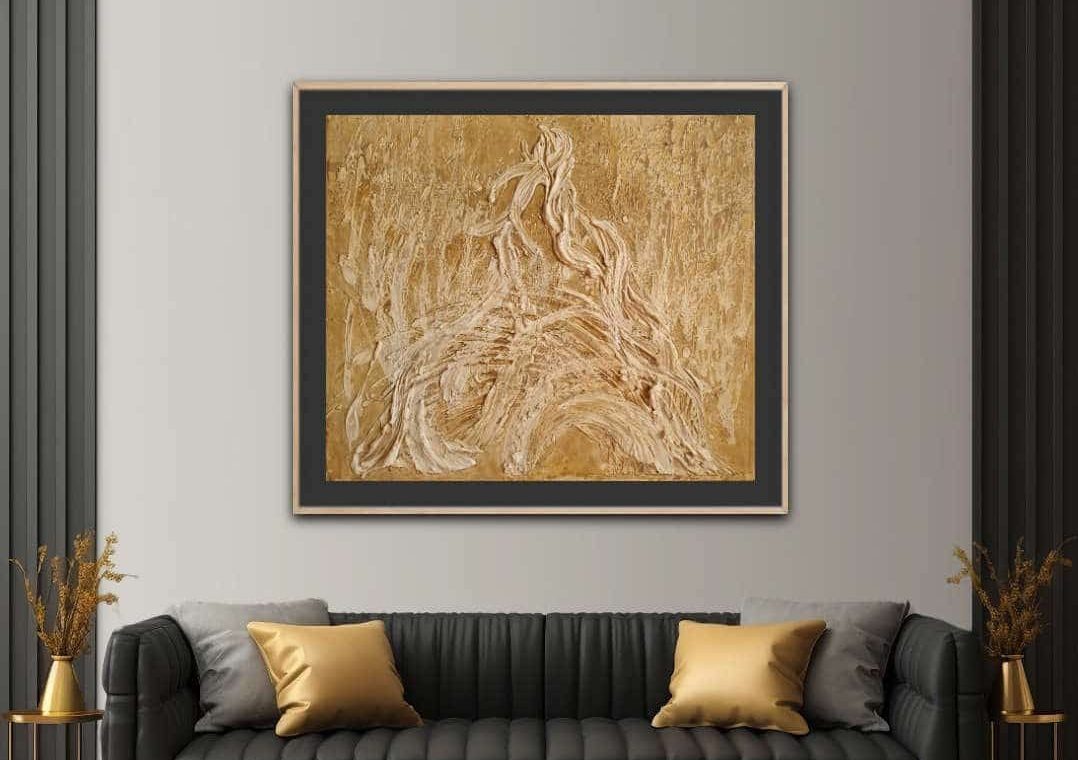
In the photograph is my painting Depth needs no explanation, it holds both weight and tenderness in the same palm, from the textured painting cycle Memory of the Currents That Shape Us.
Archaeological Note: Why the Wolf in Vinča Is Not a Myth but a Question
There is no fully researched and scientifically confirmed connection between the Vinča civilization and wolves in the sense of a cult or systematic worship, as we find in some other cultures. However, there are indications, symbolic traces, and contextual reasons that make this question entirely legitimate.
What we know from archaeology is that no clear depictions of wolves have been found on Vinča figurines or pottery. Unlike birds, snakes, or abstract symbols, for example, there is no evidence of a wolf cult in the ritual sense, such as altars, mass bone deposits, or established iconography. Dogs, however, were present as domesticated animals, which osteological analyses confirm.
So, if we are looking for a direct iconographic or cultic connection between Vinča and the wolf, it has not been confirmed.
Seen from a broader cultural and symbolic context, Vinča belongs to the Old European cultural layer, a term used by Marija Gimbutas, which predates the Indo-European warrior cultures. Within that layer, feminine, cyclical, and earth-based symbols are dominant. Animals are not treated as totems of power, but as related beings within the ecosystem, and the emphasis is not on predation, but on balance.
The wolf, as a symbol, is not primarily cyclical, but territorial and hierarchical. It is often associated with warrior brotherhoods, initiations, and male alliances, and it gains a more central place with the Indo-European cultures that appear later, around and after 4000 BCE.
From an ecological point of view, the people of Vinča lived in a landscape where wolves naturally existed. The wolf was part of their world, but not the center of its symbolism.
From a psychological and archetypal point of view, the WOLF symbolizes the boundary between the wild and the domesticated, instinct and the collective, the pack. VINČA, however, chooses a different archetype of the center: a close relationship with nature and its cycles, aligned with the cyclical energy of woman, community, home, hearth, and peace.
As a result of this exploration, I conclude that Vinča was a civilization that existed before the wolf became a symbol of power. The wolf comes later, with a world of conflict, conquest, and borders. In that sense, the absence of the wolf in Vinča is a message in itself. It speaks of a different system of values. Vinča was a civilization that did not need to symbolize power through a predator. That came later, with the disruption of balance.